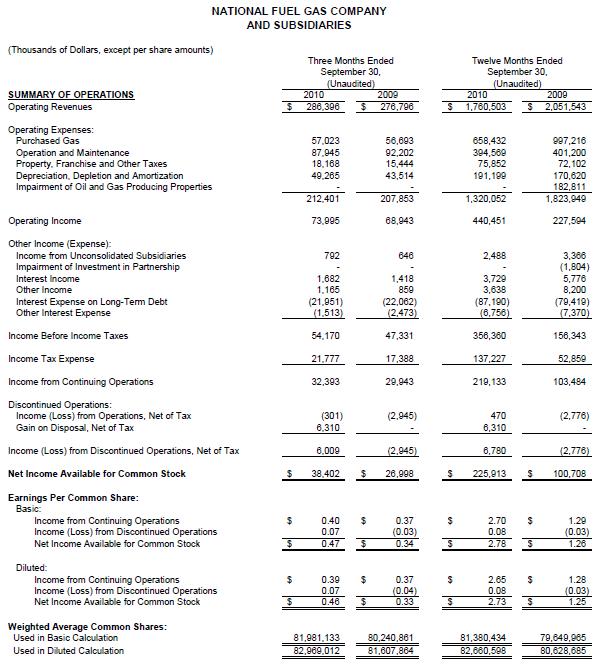
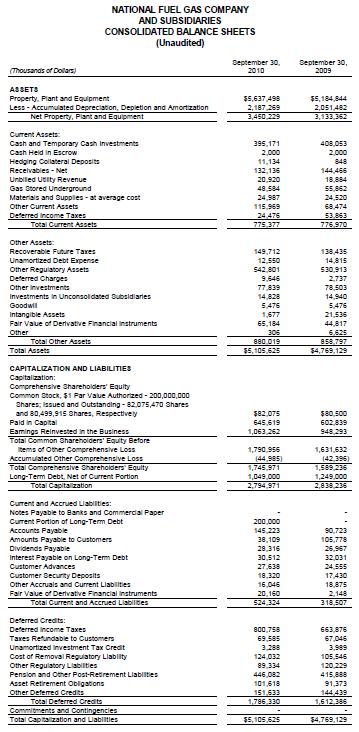
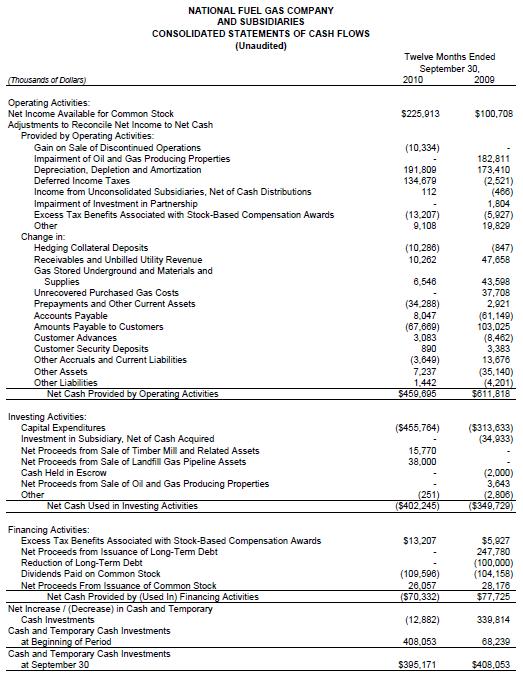
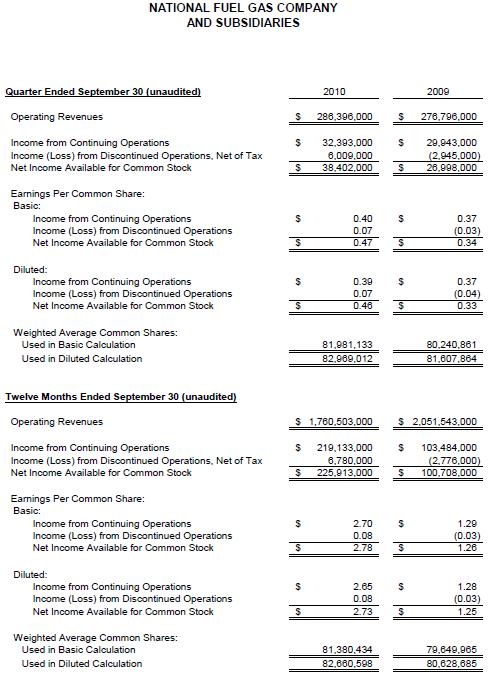
Williamsville, N.Y.: National Fuel Gas Company (“National Fuel” or the “Company”) (NYSE:NFG) today announced consolidated earnings for the fourth quarter and fiscal year ended September 30, 2010, of $38.4 million, or $0.46 per share, and $225.9 million, or $2.73 per share, respectively;
HIGHLIGHTS
- Operating results before items impacting comparability (“Operating Results”) for the fourth quarter of fiscal 2010 of $32.4 million, or $0.39 per share, increased $2.5 million, or $0.02 per share compared to the prior year fourth quarter, due to higher Operating Results in the Pipeline and Storage, Utility and Energy Marketing segments.
- Operating Results for the fiscal year were $219.1 million, or $2.65 per share, an increase of $8.7 million or $0.05 per share. Increased production of natural gas and higher crude oil prices realized in the Exploration and Production segment during the current fiscal year were the main drivers of the increase.
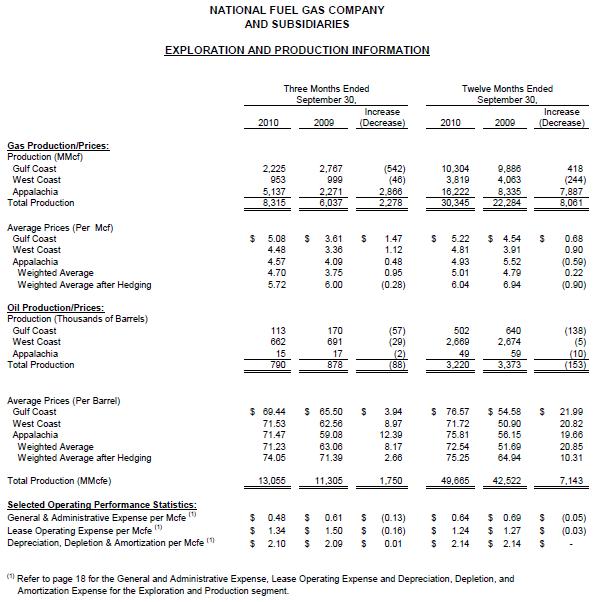
- Seneca Resources Corporation’s (“Seneca”) fourth quarter production of crude oil and natural gas increased approximately 1.8 billion cubic feet equivalent (“Bcfe”), or 15.5%, to 13.1 Bcfe. Appalachian production increased approximately 120% to 5.2 Bcfe, including production from the Marcellus Shale of 2.9 Bcfe. Total production for fiscal 2010 increased nearly 17% to 49.7 Bcfe.
- Seneca’s fiscal 2010 Marcellus Shale exit rate was approximately 53 million cubic feet per day (“MMcfd”).
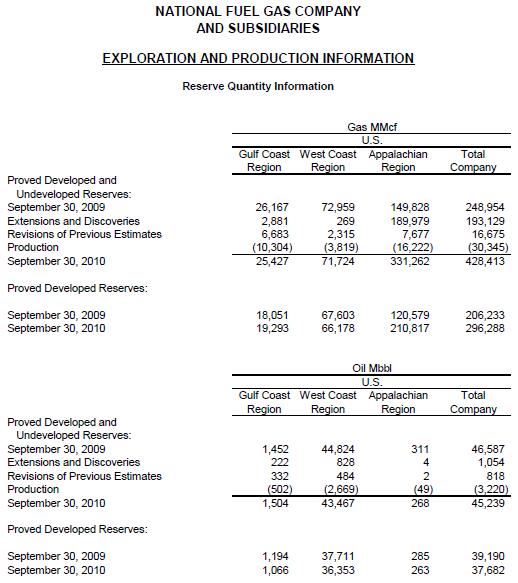
- Seneca’s total reserves at September 30, 2010, were 700 Bcfe, an increase of 171 Bcfe. Seneca replaced 445% of fiscal 2010 production.
- The Company sold its landfill gas operations and realized an after-tax gain of $6.3 million. The Company also completed the sale of its sawmill in Marienville, Pennsylvania including selected timber assets, and realized an after-tax gain of $0.2 million.
- A conference call is scheduled for Friday, November 5, 2010, at 11 a.m. Eastern Time.
MANAGEMENT COMMENTS
David F. Smith, Chairman and Chief Executive Officer of National Fuel Gas Company stated: “The fourth quarter marked the end of another excellent year for National Fuel, from both a financial and operational standpoint. The diversity of our businesses allowed for this year’s earnings to increase, with growth occurring in the Exploration and Production, Utility, and Energy Marketing segments. These increases were partially offset by a decrease in Pipeline and Storage earnings due to the effects of a shift in market dynamics associated with the development of the Marcellus Shale.”
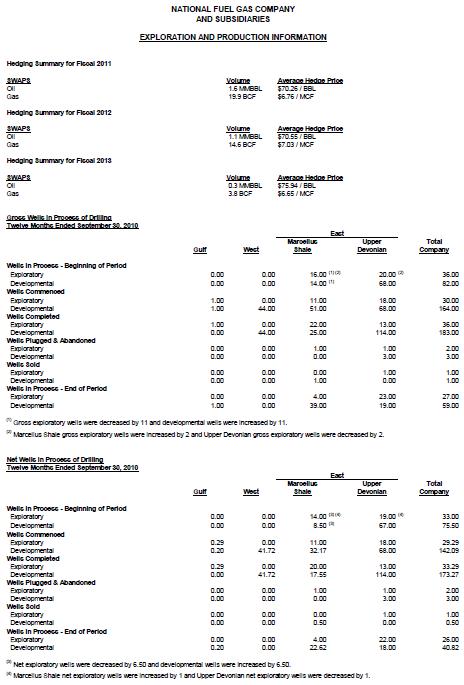
“Operationally, we made great progress on our plan to aggressively ramp up Seneca’s Marcellus development program. Since the first Seneca-operated well in Tioga County was completed and brought online in November 2009, Seneca has expanded the program significantly, drilling an additional 29 wells during this fiscal year. Seneca exited the year with net production of 53 million cubic feet per day from the Marcellus, a tremendous increase from almost no production at this same time last year.”
“During the quarter we continued to narrow our focus on the multiple growth opportunities in our core businesses. With the sale of our landfill gas and sawmill operations, we substantially decreased our investment in non-core assets. This will allow us to maintain our focus on growing production from the Marcellus Shale and increasing pipeline capacity that is critical to transport production from the Appalachian Basin to the consuming markets in the northeast and in Canada.”
“As we look forward to 2011, we will build upon the accomplishments from this past year and continue to capitalize on these exciting opportunities, while evaluating additional ways to further enhance value for our shareholders.”
SUMMARY OF RESULTS
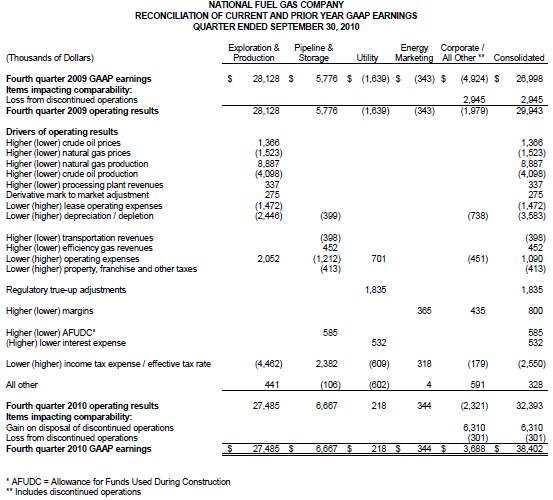
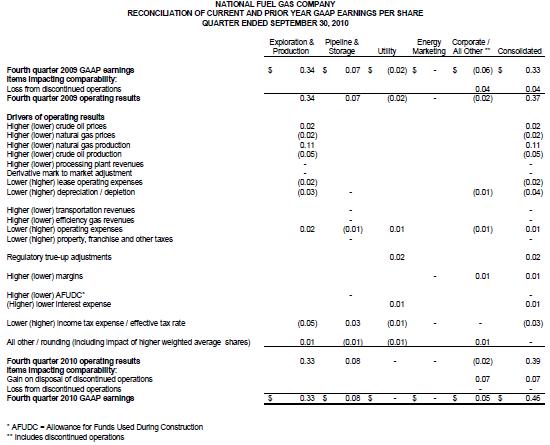
National Fuel had consolidated earnings for the quarter ended September 30, 2010, of $38.4 million, or $0.46 per share, compared to the prior year’s fourth quarter earnings of $27.0 million, or $0.33 per share, an increase of $11.4 million or $0.13 per share. (Note: All references to earnings per share are to diluted earnings per share. All amounts are stated in U.S. dollars, and all amounts used in the discussion of earnings and operating results before items impacting comparability (“Operating Results”) are after tax unless otherwise noted).
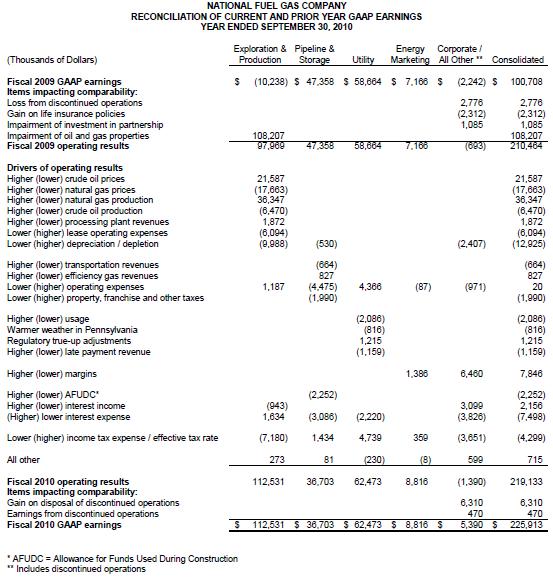
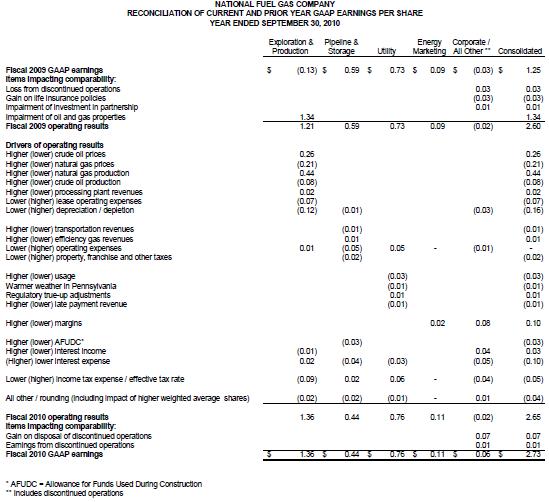
Consolidated earnings for the fiscal year ended September 30, 2010, of $225.9 million, or $2.73 per share, increased $125.2 million, or $1.48 per share, from the prior fiscal year, where earnings were $100.7 million or $1.25 per share.
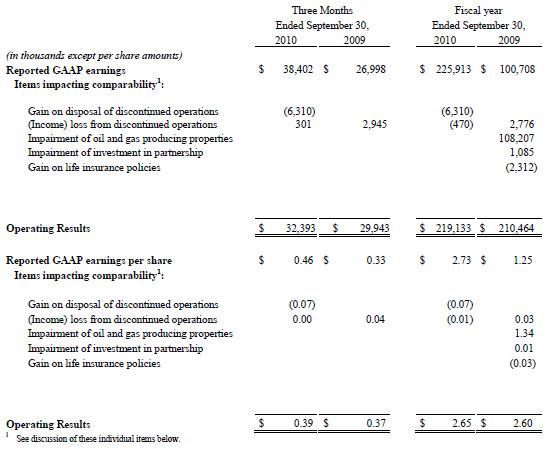
As outlined in the table above, certain items included in GAAP earnings impacted the comparability of the Company’s financial results when comparing the quarter and fiscal year ended September 30, 2010, to the comparable periods in fiscal 2009. Excluding these items, Operating Results for the current fourth quarter of $32.4 million, or $0.39 per share, increased $2.5 million or $0.02 per share. Excluding these items, Operating Results for fiscal year ended September 30, 2010, of $219.1 million, or $2.65 per share, increased $8.7 million, or $0.05 per share, from the prior fiscal year. Items impacting comparability will be discussed in more detail within the discussion of segment earnings below.
The items noted above that impacted the comparability of the financial results also had an impact on the consolidated effective tax rate in each year. Excluding these items, the consolidated effective tax rate of 38.4 percent for the fiscal year ended September 30, 2010 is comparable to the consolidated effective tax rate of 37.7 percent for the prior fiscal year.
DISCUSSION OF RESULTS BY SEGMENT
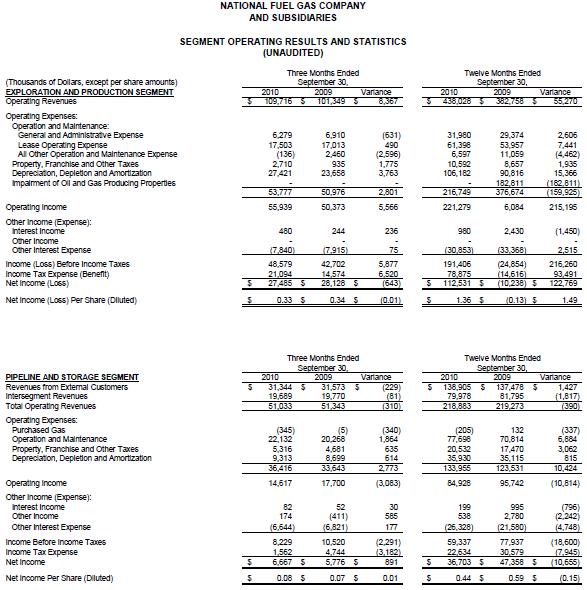
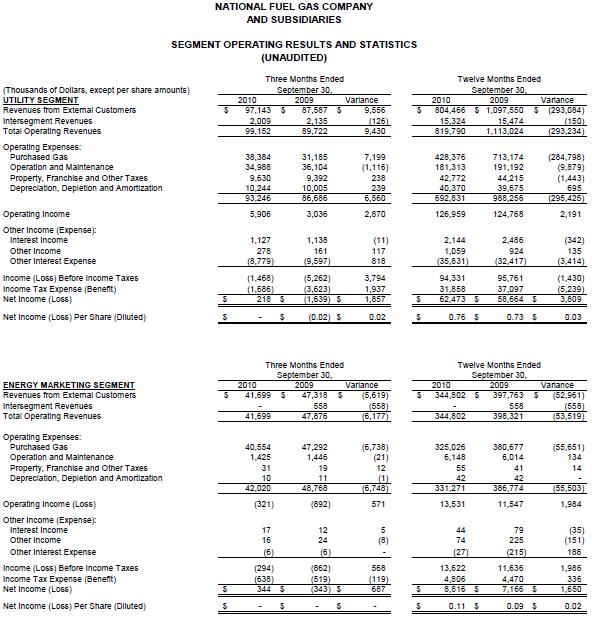
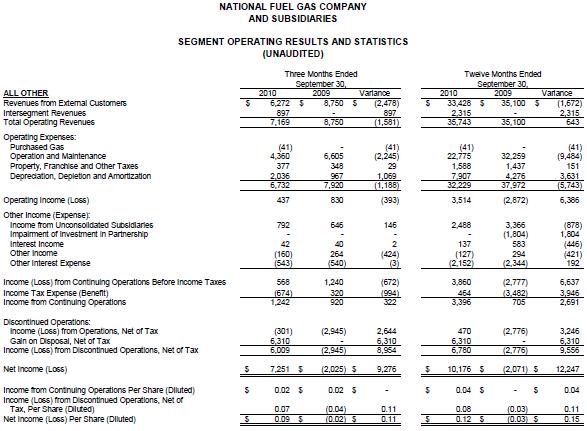
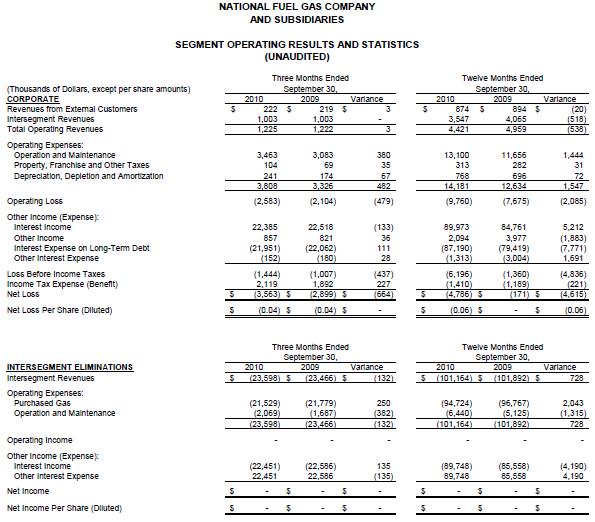
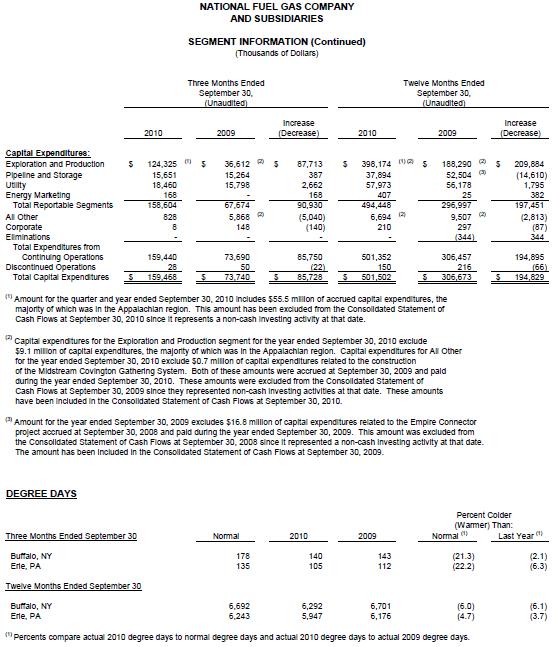
(The following discussion of earnings for each segment is summarized in a tabular form at pages 11 through 14 of this report. It may be helpful to refer to those tables while reviewing this discussion.)
Exploration and Production Segment
The Exploration and Production segment operations are carried out by Seneca Resources Corporation (“Seneca”). Seneca explores for, develops and purchases natural gas and oil reserves in California, in the Appalachian region and in the Gulf of Mexico.
The Exploration and Production segment’s earnings in the fourth quarter of fiscal 2010 of $27.5 million, or $0.33 per share, decreased $0.6 million, or $0.01 per share, when compared with the prior year’s fourth quarter. The decrease is mainly due to a higher effective tax rate in the current quarter relating to effects associated with a federal tax law change. Excluding the impact of the higher effective income tax rate, the Exploration and Production segment earnings increased by $3.8 million.
Overall production for the current quarter of 13.1 Bcfe increased approximately 1.8 Bcfe, or 15.5 percent, compared to the prior year’s fourth quarter. Production increased approximately 120 percent in Appalachia mainly due to higher production from Marcellus wells of 2.9 Bcfe. In the Gulf of Mexico, production decreased 0.9 Bcfe. Production in California decreased 0.2 Bcfe.
In addition to the higher production, higher crude oil prices realized after hedging had a positive impact on earnings for the quarter. Lower natural gas prices realized after hedging reduced earnings. For the quarter ended September 30, 2010, the weighted average oil price received by Seneca (after hedging) was $74.05 per barrel (“Bbl”), an increase of $2.66 per Bbl from the prior year’s quarter. The weighted average natural gas price received by Seneca (after hedging) for the quarter ended September 30, 2010, was $5.72 per thousand cubic feet (“Mcf”), a decrease of $0.28 per Mcf.
Several other items also impacted earnings for the quarter including: higher lease operating expenses (“LOE”) (mainly due to the costs to transport Marcellus production in Appalachia and higher steam fuel costs in California), higher depletion expense (due mainly to the increase in the depletable base and higher production), lower other operating expenses (attributable mostly to decreased plugging and abandonment costs), and lower general and administrative (“G&A”) expenses (a $2.5 million bad debt recovery more than offset additional staffing and associated costs in the East Division).
The Exploration and Production segment’s earnings of $112.5 million, or $1.36 per share, for the fiscal year ended September 30, 2010, compares to a loss of $10.2 million, or $0.13 per share, for the fiscal year ended September 30, 2009. The increase was mainly due to the non-cash impairment charge of $108.2 million taken in the first quarter of fiscal 2009 to write down the value of Seneca’s oil and natural gas producing properties. Seneca uses the full cost method of accounting for determining the book value of its oil and natural gas properties. This accounting method requires that Seneca perform a quarterly “ceiling test” to compare the present value of future revenues from its oil and natural gas reserves based on 12-month average spot prices (the “ceiling”) with the book value of those reserves at the balance sheet date. If the book value of the reserves exceeds the ceiling calculation, a non-cash impairment charge must be recorded in order to reduce the book value of the reserves to the calculated ceiling. The impairment at December 31, 2008, (which was calculated using quarter-end pricing under the then effective full cost ceiling test rules) was mainly driven by a significant decrease in commodity prices. At September 30, 2010, the ceiling exceeded the book value of Seneca’s oil and gas properties by approximately $270 million.
Excluding the impact of the ceiling test charge in the prior year’s first quarter, Operating Results for the fiscal year ended September 30, 2010, of $112.5 million, or $1.36 per share, increased $14.6 million, or $0.15 per share, from the prior year. The increase was primarily due to higher natural gas production and higher crude oil prices realized after hedging.
Overall production for the fiscal year ended September 30, 2010, increased 16.8 percent to 49.7 Bcfe, an increase of 7.1 Bcfe compared to the prior fiscal year. Production increased approximately 7.8 Bcfe or 90 percent in Appalachia. Marcellus production of 7.2 Bcfe and higher production from upper Devonian wells more than offset small production declines in California and the Gulf of Mexico.
In addition to overall higher production, higher crude oil prices realized after hedging contributed to the increase in Operating Results for the fiscal year. Lower natural gas prices realized after hedging reduced Operating Results. For the fiscal year ended September 30, 2010, the weighted average oil price received by Seneca (after hedging) was $75.25 per Bbl, an increase of $10.31 per Bbl from the prior fiscal year. The weighted average natural gas price received by Seneca (after hedging) for the fiscal year ended September 30, 2010, was $6.04 per Mcf, a decrease of $0.90 per Mcf.
Other items impacting Operating Results for the fiscal year ended September 30, 2010, were higher depletion expense (mainly due to the increase in production and a higher depletable base), higher LOE (mainly due to higher steam fuel cost and the operating costs associated with the July 2009 acquisition of the Ivanhoe assets in California, and the costs to transport Marcellus production in Appalachia), higher G&A expenses (attributable mostly to additional staffing and associated costs in the East Division that more than offset the recovery of a bad debt expensed in the prior year) and lower other operating expenses (primarily due to lower plugging and abandonment costs).
Pipeline and Storage Segment
The Pipeline and Storage segment operations are carried out by National Fuel Gas Supply Corporation (“Supply Corporation”) and Empire Pipeline, Inc. (“Empire”). The Pipeline and Storage segment provides natural gas transportation and storage services to affiliated and non-affiliated companies through an integrated system of pipelines and underground natural gas storage fields in western New York and western Pennsylvania.
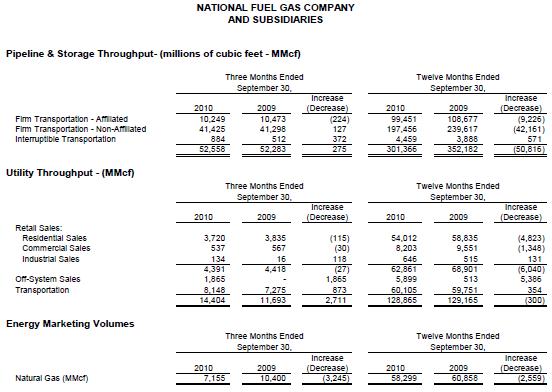
The Pipeline and Storage segment’s earnings of $6.7 million, or $0.08 per share, for the quarter ended September 30, 2010, increased $0.9 million, or $0.01 per share, when compared with the same period in the prior fiscal year. The increase in earnings is mainly due to a lower effective tax rate in the current quarter relating to the intercompany tax allocation among subsidiaries. Excluding the impact of the lower effective income tax rate, Pipeline and Storage segment earnings decreased by $1.5 million from the prior year. The decrease was mostly due to increased maintenance and pension expenses. Transportation revenues for both Supply Corporation and Empire were also lower in the current quarter compared to the fourth quarter of 2009. Persistent strong Niagara/Chippawa basis prices have caused shippers to evaluate lower cost supply sources, and certain shippers have reduced their imports of natural gas from Canada. This has resulted in some contract terminations on Supply Corporation from Niagara. In order to counteract the decrease in revenues due to these lower shipping volumes, Supply Corporation’s Northern Access expansion project and Empire’s Tioga County Extension Project have been designed to utilize the existing pipeline system to provide producers of Marcellus gas a transportation path from the Marcellus supply basins to Canadian and other northern markets.
The Pipeline and Storage segment’s earnings of $36.7 million, or $0.44 per share, for the fiscal year ended September 30, 2010, decreased $10.7 million, or $0.15 per share, when compared with the fiscal year ended September 30, 2009. The decrease in earnings for the current fiscal year was due to lower transportation revenues, higher operating expenses (mainly due to increased pension and other operating expenses), higher property taxes and interest expense and lower AFUDC (attributable to the completion of the Empire Connector in December 2008).
Utility Segment
The Utility segment operations are carried out by National Fuel Gas Distribution Corporation (“Distribution”), which sells or transports natural gas to customers located in western New York and northwestern Pennsylvania.
The Utility segment’s earnings of $0.2 million, for the quarter ended September 30, 2010, compared to a loss of $1.6 million, for the quarter ended September 30, 2009. The change is primarily due to lower operating expenses (including a $1.3 million after-tax adjustment recorded to reduce Distribution’s allowance for doubtful accounts), lower interest expense on over recoveries of purchased gas costs and the impact of certain regulatory true-up adjustments.
The Utility segment’s earnings of $62.5 million, or $0.76 per share, for the fiscal year ended September 30, 2010, increased from earnings of $58.7 million, or $0.73 per share, for the fiscal year ended September 30, 2009. Earnings in the New York Division for the fiscal year ended September 30, 2010, of $39.5 million, or $0.48 per share, increased $1.8 million, or $0.01 per share, compared to the prior year. Lower operating expenses (mainly attributable to a decrease in bad debt expense) and the impact of regulatory true-up adjustments more than offset the impact of lower revenues from customer late payment charges (mainly due to lower gas costs) during the current fiscal year.
For the fiscal year ended September 30, 2010, earnings in the Pennsylvania Division of $23.0 million, or $0.28 per share, increased $2.0 million, or $0.02 per share, compared to the prior year. Lower operating expenses (mainly attributable to a decrease in bad debt expense) and a lower effective tax rate more than offset higher interest expense, warmer weather and lower customer usage during the current fiscal year.
Energy Marketing
National Fuel Resources, Inc. (“NFR”) comprises the Company’s Energy Marketing segment. NFR markets natural gas to industrial, wholesale, commercial, public authority and residential customers primarily in western and central New York and northwestern Pennsylvania, offering competitively priced natural gas to its customers.
The Energy Marketing segment’s earnings for the quarter ended September 30, 2010, of $0.3 million compared to a loss of $0.3 million in the prior year fourth quarter. The increase in earnings in the current year fourth quarter is primarily due to proceeds NFR received as a member of a class of claimants in a class action litigation settlement. Excluding this item earnings were consistent with the fourth quarter of the prior fiscal year. The Energy Marketing segment’s earnings for the fiscal year ended September 30, 2010 of $8.8 million increased $1.7 million compared to the prior year. The increase in earnings was mainly due to higher margins in the current fiscal year and proceeds NFR received as a member of a class of claimants in a class action litigation settlement.
Corporate and All Other
The Corporate and All Other category includes the following active, wholly owned subsidiaries of the Company: National Fuel Gas Midstream Corporation (“Midstream”), formed to build, own and operate natural gas processing and pipeline gathering facilities in the Appalachian region; Horizon Power, Inc., a corporation that develops and owns independent electric generation facilities that are fueled by natural gas or landfill gas; and Highland Forest Resources, Inc., a corporation that markets high quality hardwoods from Appalachian land holdings.
Earnings in the Corporate and All Other category for the quarter ended September 30, 2010, were $3.7 million compared to the prior year’s fourth quarter loss of $4.9 million. On September 1, 2010, the Company completed the sale of its landfill gas operations. As a result of this transaction, the Company is presenting the landfill gas operations as discontinued operations. Earnings in the fourth quarter of fiscal 2010 include earnings from discontinued operations of $6.0 million, which included a $0.3 million loss from discontinued operations during the quarter plus a $6.3 million gain on the sale of the landfill gas operations. Earnings in the fourth quarter of fiscal 2009 include a loss from discontinued operations of $2.9 million. The results of discontinued operations are discussed later in this document and are excluded from the remaining discussion of the Corporate and All Other category quarterly results below.
Excluding discontinued operations, Operating Results in the Corporate and All Other category decreased from a loss of $2.0 million in the prior year fourth quarter to a loss of $2.3 million in the current year fourth quarter. Higher corporate operating expenses and lower earnings from timber operations more than offset earnings from Midstream’s pipeline gathering and natural gas processing operations.
Earnings in the Corporate and All Other category for the fiscal year ended September 30, 2010, were $5.4 million compared to a loss of $2.2 million in the prior fiscal year. As discussed above, as a result of the Company’s sale of its landfill gas operations, the Company is presenting these operations as discontinued operations. Earnings for the fiscal year ended September 30, 2010, include earnings from discontinued operations of $6.8 million, which consists of $0.5 million of income from discontinued operations, and a $6.3 million gain on the sale of the landfill gas operations. Earnings for the fiscal year ended September 30, 2009, include a loss from discontinued operations of $2.8 million. The results of discontinued operations are discussed later in this document and are excluded from the remaining discussion of the Corporate and All Other category fiscal year results below.
The comparability of the Corporate and All Other category earnings for the fiscal years ended September 30, 2010, and 2009 was also impacted by a $2.3 million gain recognized on corporate-owned executive life insurance policies and a $1.1 million impairment in the value of Horizon Power’s 50 percent investment in Energy Systems North East, LLC, both of which occurred in the prior year’s first quarter.
Excluding discontinued operations and the items discussed in the immediate preceding paragraph above, Operating Results for the fiscal year ended September 30, 2010, decreased from a loss of $0.7 million for fiscal 2009 to a loss of $1.4 million for fiscal 2010. Revenues from Midstream’s pipeline gathering and processing operations, higher margins from the timber operations (mainly due to lower prices paid for purchased logs and stumpage) and higher interest income were offset by higher depreciation and operating expenses and higher interest expense.
Discontinued Operations
Earnings from discontinued operations for the quarter and fiscal year ended September 30, 2010, increased by $8.9 million and $9.6 million, respectively. The increases are primarily the result of the Company’s sale of its landfill gas operations and the recording of a gain of approximately $6.3 million. They also reflect the nonrecurrence of a $2.8 million impairment of landfill gas assets that was recorded during the quarter ended September 30, 2009.
EARNINGS GUIDANCE
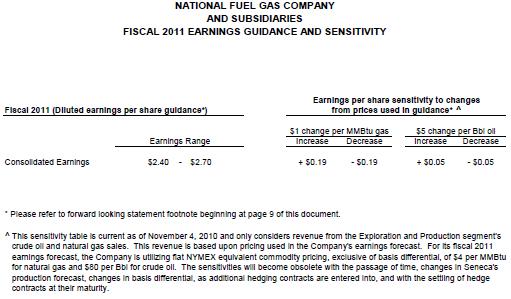
The Company is revising its GAAP earnings guidance for fiscal 2011 to a range of $2.40 to $2.70 per share. This updated guidance assumes average NYMEX prices, exclusive of basis differentials, of $4.00 per Million British Thermal Units (“MMBtu”) for natural gas and $80.00 per Bbl for crude oil. The previous guidance range of $2.60 to $2.90 per share had assumed average NYMEX prices, exclusive of basis differentials, of $5.00 per MMBtu for natural gas and $80.00 per Bbl for crude oil. The change in guidance is attributable solely to the $1.00 per MMBtu decrease in the assumed NYMEX natural gas price. Seneca’s production guidance remains unchanged at 60 to 70 Bcfe.
EARNINGS TELECONFERENCE
The Company will host a conference call on Friday, November 5, 2010, at 11 a.m. Eastern Time to discuss this announcement. There are two ways to access this call. For those with Internet access, visit the Investor Relations page on National Fuel’s website at investor.nationalfuelgas.com. For those without Internet access, access is also provided by dialing (toll-free) 1-800-561-2813, using the passcode “34046805.” For those unable to listen to the live conference call, a replay will be available at approximately 2 p.m. Eastern Time at the same website link and by phone at (toll-free) 1-888-286-8010, using passcode “78038698.” Both the webcast and telephonic replay will be available until the close of business on Friday, November 12, 2010.
National Fuel is an integrated energy company with $5.1 billion in assets comprised of the following four operating segments: Exploration and Production, Pipeline and Storage, Utility, and Energy Marketing. Additional information about National Fuel is available at www.nationalfuelgas.com or through its investor information service at 1-800-334-2188.
| Analyst Contact: |
|
Timothy J. Silverstein |
|
716-857-6987 |
| Media Contact: |
|
Donna L. DeCarolis |
|
716-857-7872 |
Certain statements contained herein, including those regarding estimated future earnings, and statements that are identified by the use of the words “anticipates,” “estimates,” “expects,” “forecasts,” “intends,” “plans,” “predicts,” “projects,” “believes,” “seeks,” “will,” “may” and similar expressions, are “forward-looking statements” as defined by the Private Securities Litigation Reform Act of 1995. Forward-looking statements involve risks and uncertainties, which could cause actual results or outcomes to differ materially from those expressed in the forward-looking statements. The Company’s expectations, beliefs and projections contained herein are expressed in good faith and are believed to have a reasonable basis, but there can be no assurance that such expectations, beliefs or projections will result or be achieved or accomplished. In addition to other factors, the following are important factors that could cause actual results to differ materially from those discussed in the forward-looking statements: financial and economic conditions, including the availability of credit, and their effect on the Company’s ability to obtain financing on acceptable terms for working capital, capital expenditures and other investments; occurrences affecting the Company’s ability to obtain financing under credit lines or other credit facilities or through the issuance of commercial paper, other short-term notes or debt or equity securities, including any downgrades in the Company’s credit ratings and changes in interest rates and other capital market conditions; changes in economic conditions, including global, national or regional recessions, and their effect on the demand for, and customers’ ability to pay for, the Company’s products and services; the creditworthiness or performance of the Company’s key suppliers, customers and counterparties; economic disruptions or uninsured losses resulting from terrorist activities, acts of war, major accidents, fires, hurricanes, other severe weather, pest infestation or other natural disasters; changes in demographic patterns and weather conditions; changes in the availability and/or price of natural gas or oil and the effect of such changes on the accounting treatment of derivative financial instruments or the valuation of the Company’s natural gas and oil reserves; impairments under the SEC’s full cost ceiling test for natural gas and oil reserves; uncertainty of oil and gas reserve estimates; factors affecting the Company’s ability to successfully identify, drill for and produce economically viable natural gas and oil reserves, including among others geology, lease availability, weather conditions, shortages, delays or unavailability of equipment and services required in drilling operations, insufficient gathering, processing and transportation capacity, and the need to obtain governmental approvals and permits and comply with environmental laws and regulations; significant differences between the Company’s projected and actual production levels for natural gas or oil; changes in the availability and/or price of derivative financial instruments; changes in the price differentials between oil having different quality and/or different geographic locations, or changes in the price differentials between natural gas having different heating values and/or different geographic locations; changes in laws and regulations to which the Company is subject, including those involving derivatives, taxes, safety, employment, climate change, other environmental matters, and exploration and production activities such as hydraulic fracturing; the nature and projected profitability of pending and potential projects and other investments, and the ability to obtain necessary governmental approvals and permits; significant differences between the Company’s projected and actual capital expenditures and operating expenses, and unanticipated project delays or changes in project costs or plans; inability to obtain new customers or retain existing ones; significant changes in competitive factors affecting the Company; governmental/regulatory actions, initiatives and proceedings, including those involving derivatives, acquisitions, financings, rate cases (which address, among other things, allowed rates of return, rate design and retained natural gas), affiliate relationships, industry structure, franchise renewal, and environmental/safety requirements; unanticipated impacts of restructuring initiatives in the natural gas and electric industries; ability to successfully identify and finance acquisitions or other investments and ability to operate and integrate existing and any subsequently acquired business or properties; changes in actuarial assumptions, the interest rate environment and the return on plan/trust assets related to the Company’s pension and other post-retirement benefits, which can affect future funding obligations and costs and plan liabilities; significant changes in tax rates or policies or in rates of inflation or interest; significant changes in the Company’s relationship with its employees or contractors and the potential adverse effects if labor disputes, grievances or shortages were to occur; changes in accounting principles or the application of such principles to the Company; the cost and effects of legal and administrative claims against the Company or activist shareholder campaigns to effect changes at the Company; increasing health care costs and the resulting effect on health insurance premiums and on the obligation to provide other post-retirement benefits; or increasing costs of insurance, changes in coverage and the ability to obtain insurance. The Company disclaims any obligation to update any forward-looking statements to reflect events or circumstances after the date hereof.