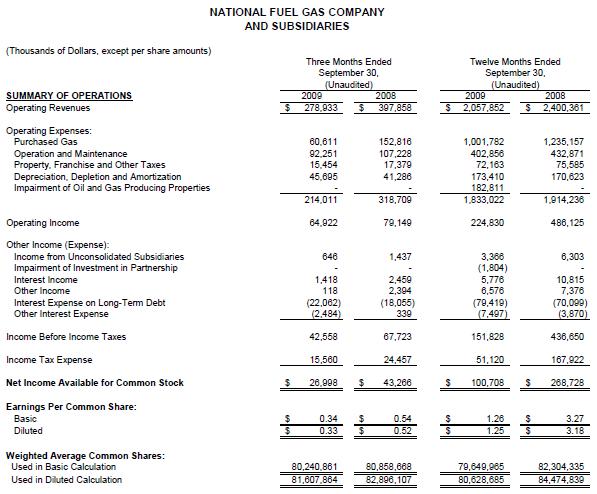
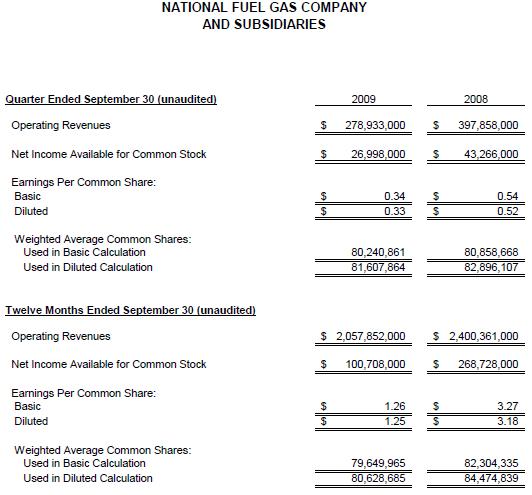
Williamsville, New York: National Fuel Gas Company (“National Fuel” or the “Company”) (NYSE:NFG) today announced consolidated earnings for its fourth quarter and fiscal year ended September 30, 2009, of $27.0 million or $0.33 per share, and $100.7 million or $1.25 per share, respectively.
HIGHLIGHTS
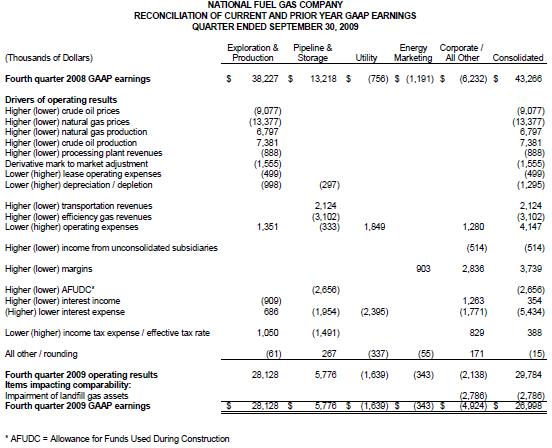
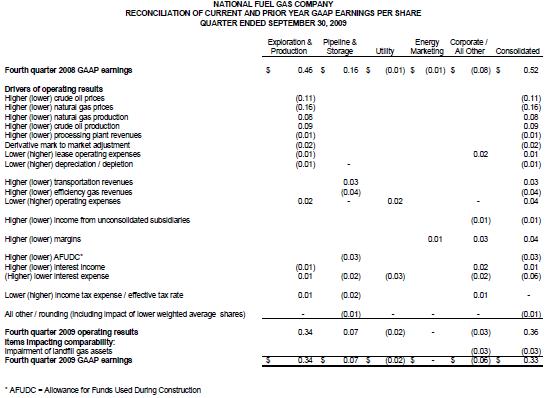
- Operating results before items impacting comparability (“Operating Results”) for the fourth quarter of fiscal 2009 of $29.8 million, or $0.36 per share, decreased $13.5 million from the prior fiscal year. A 28% decrease in average commodity prices realized this quarter in the Exploration and Production segment was the main driver of the decrease in earnings.
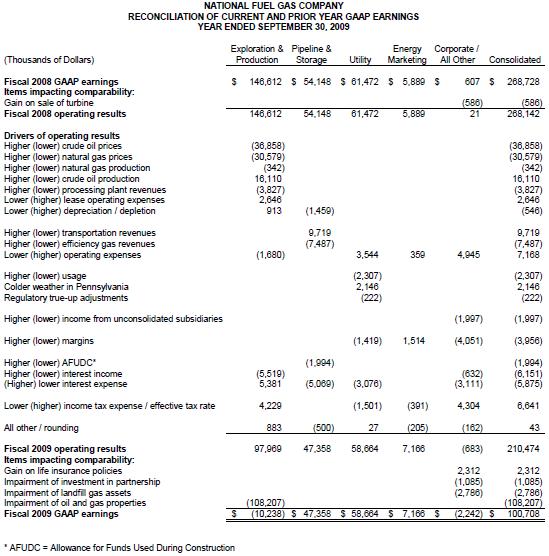
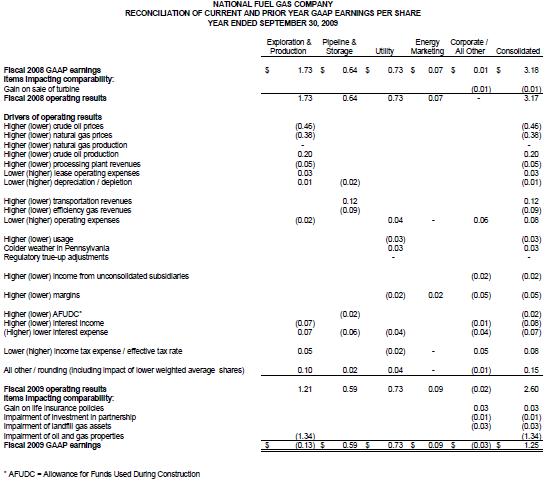
- Operating Results for fiscal 2009 of $210.5 million, or $2.60 per share, decreased $57.7 million from the prior fiscal year. A 22% decrease in average commodity prices realized over the entire year in the Exploration and Production segment was the main driver of the decrease in earnings.
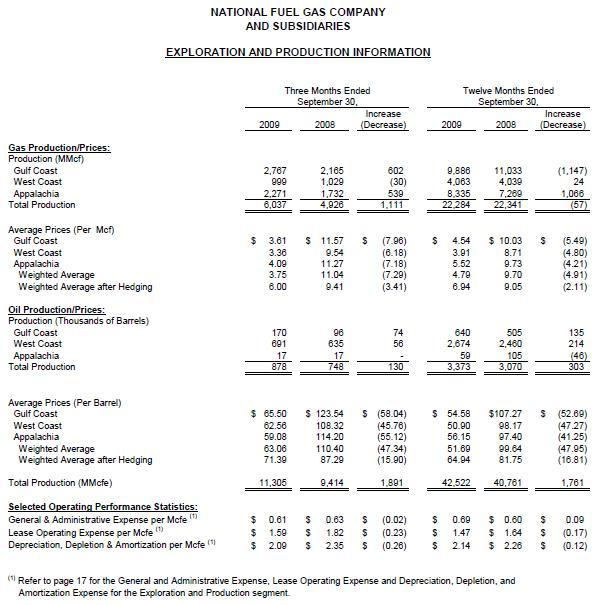
- Production in the Exploration and Production segment for the current quarter increased over 20% compared to the prior year’s fourth quarter. Comparing the fourth quarter of 2009 to the fourth quarter of 2008, Appalachian production increased 29%, California production increased 6%, and Gulf of Mexico production increased 38%. Total production for fiscal 2009 was 42.5 billion cubic feet equivalent (“Bcfe”).
- Seneca flare tested its second company-operated Marcellus Shale horizontal well at an average rate of 4.7 million cubic feet per day (“MMcfd”) over a 7-day period. To date Seneca has drilled four horizontal Marcellus Shale wells and fracture stimulated and tested two, at a combined rate for those two wells of over 10 MMcfd.
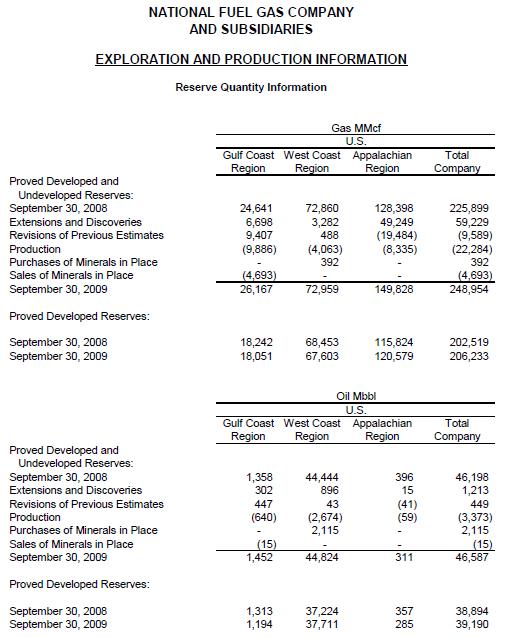
- Seneca’s reserve replacement ratio for the year was 160%. In Appalachia 341% of production was replaced. Seneca added 21.2 Bcfe of Marcellus Shale Proved Reserves at a Finding & Development Cost of $1.28 per thousand cubic feet (“Mcf”), excluding the cost of lease acquisitions.
- Phase 1 of Midstream Corporation’s Covington Gathering System is expected to be completed and transporting Marcellus production to market by mid November (a construction time of less than 6 months).
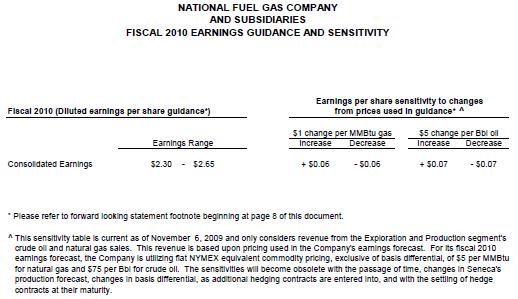
- Seneca is accelerating its drilling plans in the Marcellus shale during fiscal 2010. A second Seneca-operated horizontal drilling rig will arrive later this month. We are now estimating a total of 50 to 60 horizontal wells will be drilled in fiscal 2010, approximately half of which will be operated by EOG in the joint venture. The Company is revising its GAAP earnings guidance for fiscal 2010 to a range of $2.30 to $2.65 per share. The previous guidance range had been $2.30 to $2.60. This guidance includes an increase in the upper end of our oil and gas production range for the Exploration and Production segment. The production range is now 42 to 50 Bcfe and is based on an assumed average NYMEX price, exclusive of basis differential, of $5.00 per Million British Thermal Units (“MMBtu”) for natural gas and $75.00 per barrel (“Bbl”) for crude oil. The previous production range was 42 to 48 Bcfe.
- A conference call is scheduled for Friday, November 6, 2009, at 11:00 a.m. Eastern Time.
MANAGEMENT COMMENTS
David F. Smith, Chief Executive Officer and President of National Fuel Gas Company stated: “Overall, the fourth quarter was an excellent one for National Fuel. While commodity prices certainly impacted the level of earnings in our Exploration and Production segment, we had an outstanding quarter from an operating point of view, with production up 20% over the prior year.”
“More importantly, we continue to make great progress on our strategic initiatives in Appalachia. We have now completed two Seneca-operated horizontal wells in the Marcellus, and are very pleased with the results of each of the wells. Just as significant, we are also completing construction of the Covington Gathering System, which will get that production to market, and expect to place it in service by mid November. We have substantial running room in the Marcellus, and I firmly believe our accomplishments this quarter demonstrate that National Fuel has the people, knowledge and skills to capitalize on this exciting opportunity.”
SUMMARY OF RESULTS
National Fuel had consolidated earnings for the quarter ended September 30, 2009, of $27.0 million or $0.33 per share, a decrease of $16.3 million, or $0.19 per share, from the prior year’s fourth quarter earnings. (Note: all references to earnings per share are to diluted earnings per share, all amounts are stated in U.S. dollars and all amounts used in the discussions of earnings and operating results before items impacting comparability (“Operating Results”) are stated on an after tax basis, unless otherwise noted.)
Consolidated earnings for the fiscal year ended September 30, 2009, of $100.7 million, or $1.25 per share, decreased $168.0 million, or $1.93 per share, from the prior year, where earnings were $268.7 million, or $3.18 per share. The per share amounts reflect a lower number of shares outstanding in the current quarter and fiscal year to date resulting mainly from the impact of the Company’s repurchase of approximately 5.2 million shares of National Fuel common stock in the prior fiscal year.
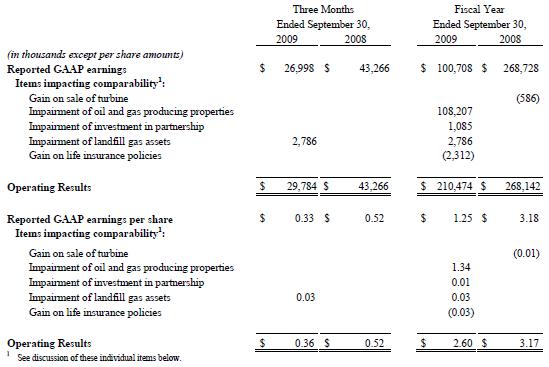
As outlined in the table above, certain items included in GAAP earnings impacted the comparability of the Company’s financial results when comparing the quarter and fiscal year ended September 30, 2009, to the comparable periods in fiscal 2008. Excluding these items, Operating Results for the current fourth quarter of $29.8 million, or $0.36 per share, decreased $13.5 million, or $0.16 per share. Excluding these items, operating results for the fiscal year ended September 30, 2009, of $210.5 million, or $2.60 per share, decreased $57.7 million, or $0.57 per share. Items impacting comparability will be discussed in more detail within the discussion of segment earnings below.
DISCUSSION OF RESULTS BY SEGMENT
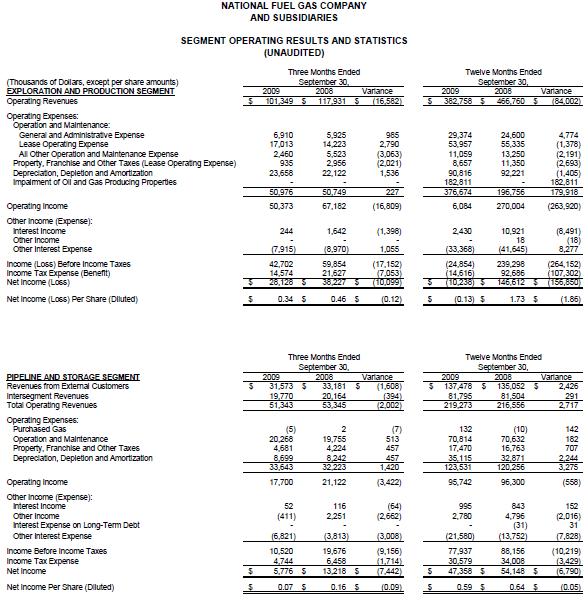
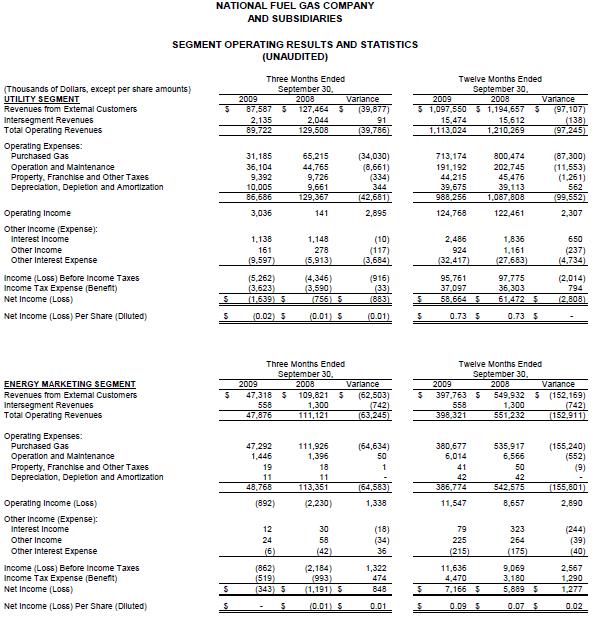
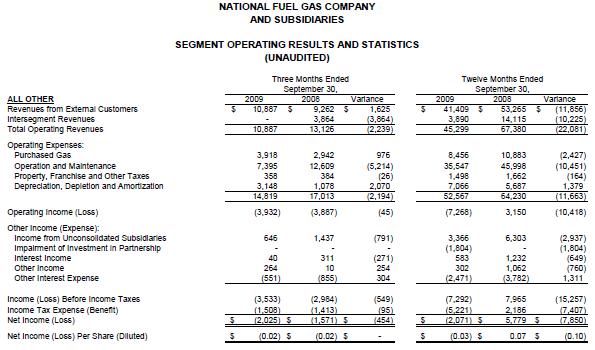
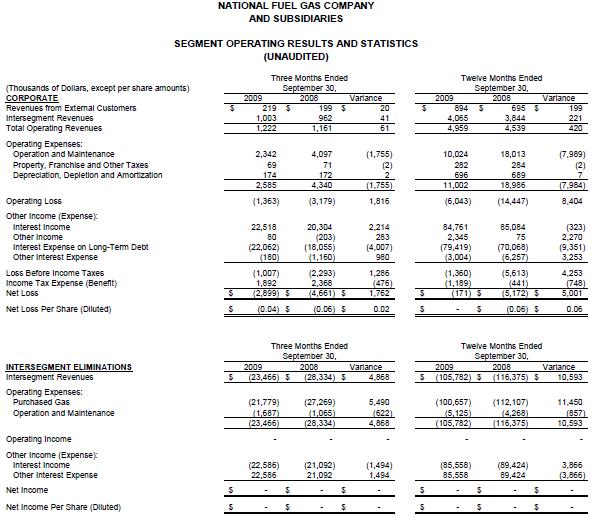
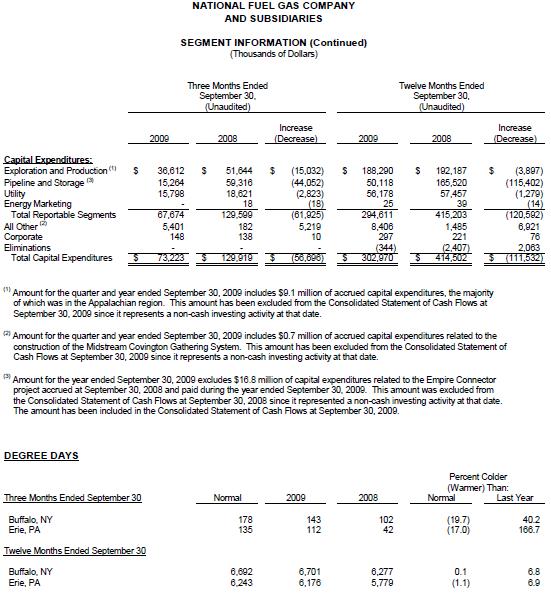
(The following discussion of earnings for each segment is summarized in a tabular form at pages 10 through 13 of this report. It may be helpful to refer to those tables while reviewing this discussion.)
Exploration and Production Segment
The Exploration and Production segment operations are carried out by Seneca Resources Corporation (“Seneca”). Seneca explores for, develops and purchases natural gas and oil reserves in California, in the Appalachian region, and in the Gulf of Mexico.
The Exploration and Production segment’s earnings in the fourth quarter of fiscal 2009 of $28.1 million, or $0.34 per share, decreased $10.1 million, or $0.12 per share, when compared with the prior year’s fourth quarter.
Crude oil and natural gas production for the current quarter of 11.3 Bcfe increased over 20 percent compared to the prior year’s fourth quarter. Production increased 29 percent in Appalachia, 38 percent in the Gulf of Mexico and six percent in California. The increase in Appalachia is largely due to the continued development by Seneca of its Upper Devonian acreage. The increase in Gulf of Mexico production is mostly due to the return to production of wells that were shut in due to hurricanes in the fourth quarter of fiscal 2008. The increase in California production is mainly due to the acquisition of Ivanhoe Energy’s U.S. oil and gas subsidiary this quarter.
In spite of higher production, lower crude oil and natural gas prices realized after hedging caused earnings to decrease. For the quarter ended September 30, 2009, the weighted average oil price received by Seneca (after hedging) was $71.39 per Bbl, a decrease of $15.90 per Bbl from the prior year’s quarter. The weighted average natural gas price received by Seneca (after hedging) for the quarter ended September 30, 2009, was $6.00 per Mcf, a decrease of $3.41 per Mcf.
Aside from the change in production and pricing, several other items impacted earnings, including higher depletion expense (due mostly to the increase in production), lower other operating expenses (which was attributable mostly to a decrease in plugging and abandonment cost), and the negative impact of period-to-period mark-to-market adjustments to recognize hedge ineffectiveness on certain derivative financial instruments used to hedge prices on Seneca’s oil and gas.
The Exploration and Production segment’s loss of $10.2 million, or $0.13 per share, for the fiscal year ended September 30, 2009, compares to earnings of $146.6 million, or $1.73 per share, for the fiscal year ended September 30, 2008. The decrease in earnings was largely due to a non-cash charge of $108.2 million in the first quarter of fiscal 2009 to write down the value of Seneca’s oil and natural gas producing properties.
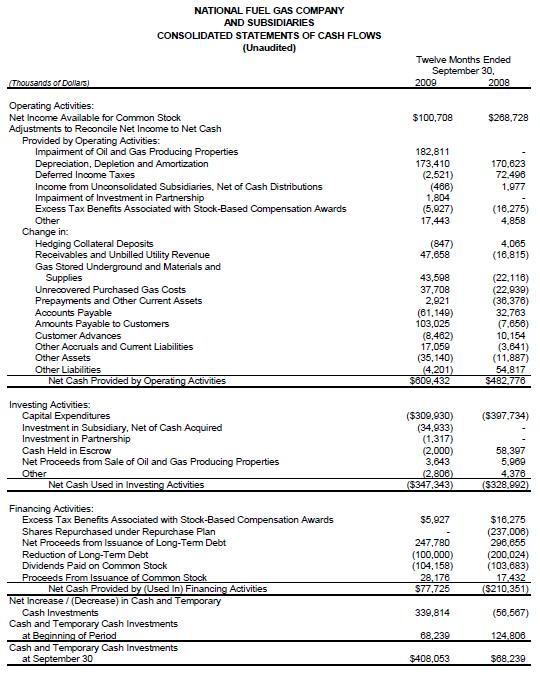
Seneca uses the full cost method of accounting for determining the book value of its oil and natural gas properties. This accounting method requires that Seneca perform a quarterly “ceiling test” to compare the present value of future revenues from its oil and natural gas reserves based on period end spot prices (the “ceiling”) with the book value of those reserves at the balance sheet date. If the book value of the reserves exceeds the ceiling calculation, a non-cash charge, or impairment, must be recorded in order to reduce the book value of the reserves to the calculated ceiling. The impairment was mainly driven by a significant decrease in commodity prices. At September 30, 2009 pricing, the ceiling exceeded the book value of the Company’s oil and gas properties by approximately $212 million.
Excluding the impact of the ceiling test charge in the first quarter of fiscal year 2009, Operating Results for the fiscal year ended September 30, 2009, of $98.0 million or $1.21 per share decreased $48.6 million, or $0.52 per share, from the prior year.
Overall production for fiscal year ended September 30, 2009, of 42.5 Bcfe increased four percent from 40.8 Bcfe in the prior fiscal year. Lower production in the Gulf of Mexico as a result of Hurricane Ike related curtailments during the year, was offset by increases of 10 percent in Appalachia and seven percent in California.
For the fiscal year ended September 30, 2009, the weighted average oil price received by Seneca (after hedging) was $64.94 per Bbl, a decrease of $16.81 per Bbl from the prior fiscal year. The weighted average natural gas price received by Seneca (after hedging) for fiscal year ended September 30, 2009, was $6.94 per Mcf, a decrease of $2.11 per Mcf.
Other items impacting Operating Results for the fiscal year ended September 30, 2009, were lower depletion and lease operating expense (“LOE”) and higher general and administrative expenses (“G&A”). Lower income taxes also had a positive impact on earnings for the current fiscal year. The decrease in depletion expense was mainly due to a lower depletable base resulting from the ceiling test impairment recorded in the first quarter of fiscal 2009 described above. The decrease in LOE is due to lower steam fuel costs in California and lower production taxes in the Gulf of Mexico. The increase in G&A expenses is due to additional staffing and other costs in the East division, and a bad debt charge related to a customer bankruptcy in California.
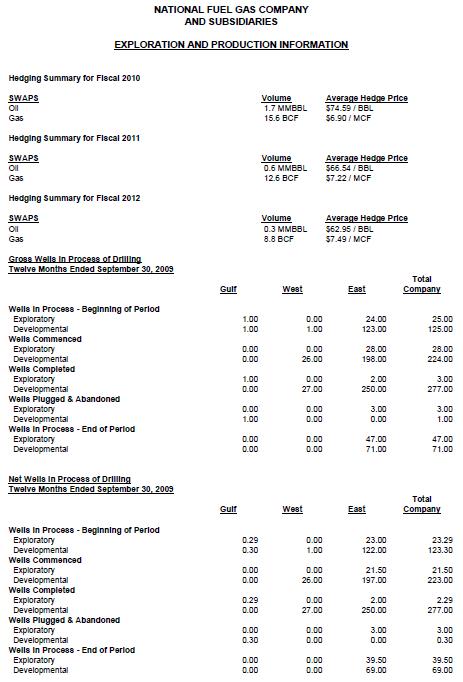
Seneca continues to evaluate and aggressively develop the Company’s significant Marcellus Shale acreage. Seneca flare tested its second company-operated Marcellus Shale horizontal well at an average rate of 4.7 MMcfd over a 7-day period. To date Seneca has drilled four horizontal Marcellus Shale wells and fracture stimulated and tested two, at a combined rate of over 10 MMcfd.
Pipeline and Storage Segment
The Pipeline and Storage segment operations are carried out by National Fuel Gas Supply Corporation (“Supply Corporation”) and Empire Pipeline, Inc. (“Empire”). These companies provide natural gas transportation and storage services to affiliated and non-affiliated companies through an integrated system of pipelines and underground natural gas storage fields in western New York and western Pennsylvania.
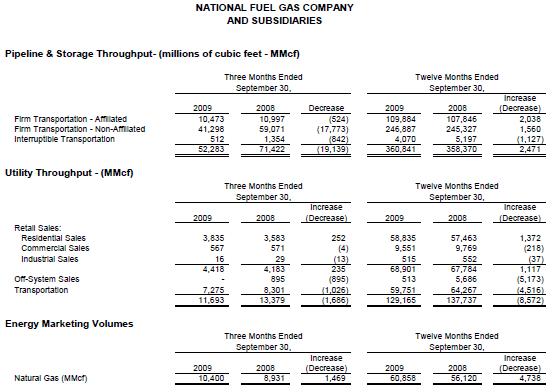
The Pipeline and Storage segment’s earnings of $5.8 million, for the quarter ended September 30, 2009, decreased $7.4 million when compared with the same period in the prior fiscal year. The decrease was primarily due to lower efficiency gas revenues, mainly the result of lower commodity prices and lower transported volumes during the quarter. Higher transportation revenues from the Empire Connector, which was placed in service in mid December 2008, partially offset this decrease. Higher interest expense and a lower allowance for funds used during construction (“AFUDC”) in the fourth quarter of the current fiscal year and a higher effective tax rate also contributed to the decrease in earnings compared to the prior year’s fourth quarter.
The Pipeline and Storage segment’s earnings of $47.4 million for the fiscal year ended September 30, 2009, decreased $6.8 million when compared with the prior fiscal year. Higher transportation revenues, mainly the result of incremental revenue from the Empire Connector, which was placed in service in mid December 2008 and the addition of several new contracts for firm transportation services were more than offset by lower efficiency gas revenues due to lower natural gas prices, higher depreciation expense, higher interest expense and lower AFUDC related to the construction of the Empire Connector in the prior fiscal year.
Utility Segment
The Utility segment operations are carried out by National Fuel Gas Distribution Corporation (“Distribution”), which sells or transports natural gas to customers located in western New York and northwestern Pennsylvania. The Utility segment’s loss of $1.6 million, or $0.02 per share, for the quarter ended September 30, 2009, compares to a loss of $0.8 million, or $0.01 per share, for the quarter ended September 30, 2008.
The New York Division’s loss increased $2.4 million due to higher interest expense. In the Pennsylvania Division, earnings increased $1.6 million. The increase is mainly due to lower operating expenses compared to the fourth quarter of fiscal 2008 partially offset by higher interest expense.
The Utility segment’s earnings of $58.7 million for the fiscal year ended September 30, 2009, decreased $2.8 million compared to the fiscal year ended September 30, 2008. Earnings in Distribution’s New York Division for the fiscal year ended September 30, 2009, of $37.7 million decreased $3.0 million compared to the prior year. Lower margins in the first quarter of fiscal 2009 primarily as a result of the rate design change approved by the New York State Public Service Commission’s December 28, 2007 rate order and higher interest expense more than offset the impact of lower operating expenses.
For the fiscal year ended September 30, 2009, earnings in Distribution’s Pennsylvania Division of $21.0 million were nearly flat compared to the prior year. The positive impact of colder weather and lower operating expenses was mostly offset by lower customer usage per account and a higher effective tax rate.
Energy Marketing
National Fuel Resources, Inc. (“NFR”) comprises the Company’s Energy Marketing segment. NFR markets natural gas to industrial, wholesale, commercial, public authority and residential customers primarily in western and central New York and northwestern Pennsylvania, offering competitively priced natural gas to its customers.
The Energy Marketing segment’s loss for the quarter ended September 30, 2009, of $0.3 million decreased from a loss of $1.2 million for the fourth quarter of last year. The improved results are primarily due to an increase in margin.
The Energy Marketing segment’s earnings for the fiscal year ended September 30, 2009, of $7.2 million increased $1.3 million compared to the prior year. An increase in margin and lower operating expenses due to lower bad debt expense were somewhat offset by higher state income taxes.
The Energy Marketing segment’s reported sales volume for fiscal 2009 was 4.7 Bcf higher than the reported sales volume for fiscal 2008. The increase in sales volume was due to physical gas sales transactions that NFR undertook at the Niagara pipeline delivery point to offset certain basis risks that NFR was exposed to under fixed basis commodity purchase contracts for Appalachian production. Such offsetting transactions had the effect of increasing revenue and volume sold, but the impact on earnings was minimal.
Corporate and All Other
The Corporate and All Other category includes the following active, wholly owned subsidiaries of the Company: Highland Forest Resources, Inc., a corporation that markets high quality hardwoods from New York and Pennsylvania land holdings; Horizon LFG, Inc., a corporation engaged, through subsidiaries, in the purchase, processing, transportation and sale of landfill gas; and Horizon Power, Inc., a corporation that develops and owns independent electric generation facilities that are fueled by natural gas or landfill gas.
The Corporate and All Other category had a loss of $4.9 million for the quarter ended September 30, 2009 compared to a loss of $6.2 million in the prior year’s fourth quarter. The comparability of the results for the quarter ended September 30, 2009, is impacted by a $2.8 million impairment of one of the landfill gas sites that transported landfill gas to a now idle manufacturing plant in Oakridge, Missouri. Excluding this item, Operating Results increased $4.1 million. Higher margins from timber operations due to the lower cost basis of the current quarter’s harvest, lower operating expenses, higher interest income and lower income taxes were the primary reasons for the decreased loss. The positive impact of these items was partially offset by lower income from unconsolidated subsidiaries and higher interest expense.
The Corporate and All Other category had a loss of $4.9 million for the quarter ended September 30, 2009 compared to a loss of $6.2 million in the prior year’s fourth quarter. The comparability of the results for the quarter ended September 30, 2009, is impacted by a $2.8 million impairment of one of the landfill gas sites that transported landfill gas to a now idle manufacturing plant in Oakridge, Missouri. Excluding this item, Operating Results increased $4.1 million. Higher margins from timber operations due to the lower cost basis of the current quarter’s harvest, lower operating expenses, higher interest income and lower income taxes were the primary reasons for the decreased loss. The positive impact of these items was partially offset by lower income from unconsolidated subsidiaries and higher interest expense.
EARNINGS GUIDANCE
The Company is revising its GAAP earnings guidance for fiscal 2010 to a range of $2.30 to $2.65 per share. The previous guidance range had been $2.30 to $2.60. This guidance includes an increase in the upper end of our oil and gas production range for the Exploration and Production segment. The production range is now 42 to 50 Bcfe and is based on an assumed average NYMEX price, exclusive of basis differential, of $5.00 per MMBtu for natural gas and $75.00 per Bbl for crude oil. The previous production range was 42 to 48 Bcfe.
EARNINGS TELECONFERENCE;
The Company will host a conference call on Friday, November 6, 2009, at 11 a.m. (Eastern Time) to discuss this announcement. There are two ways to access this call. For those with Internet access, visit the investor relations page at National Fuel’s Web site at investor.nationalfuelgas.com. For those without Internet access, access is also provided by dialing (toll-free) 1-866-578-5801, and using the passcode “70464736.” For those unable to listen to the live conference call, a replay will be available at approximately 2 p.m. (Eastern Time) at the same Web site link and by phone at (toll free) 888-286-8010 using passcode “75925727.” Both the webcast and telephonic replay will be available until the close of business on Friday, November 13, 2009.
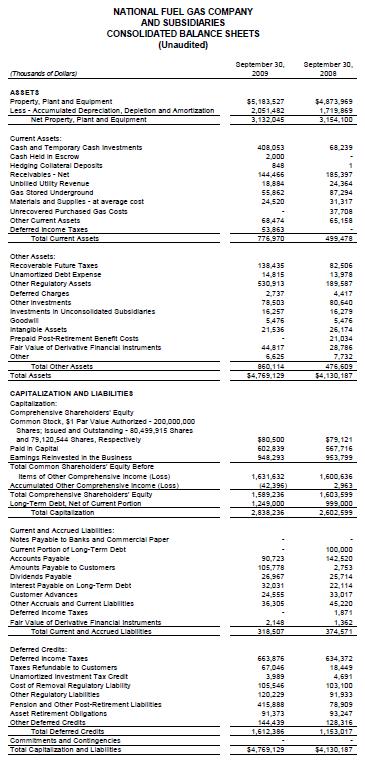
National Fuel is an integrated energy company with $4.8 billion in assets comprised of the following four operating segments: Exploration and Production, Pipeline and Storage, Utility, and Energy Marketing. Additional information about National Fuel is available on its Internet Web site: http://www.nationalfuelgas.com or through its investor information service at 1-800-334-2188.
| Analyst Contact: |
|
James C. Welch |
|
(716) 857-6987 |
| Media Contact: |
|
Julie Coppola Cox |
|
(716) 857-7079 |
The Securities and Exchange Commission (the “SEC”) currently permits oil and gas companies, in their filings with the SEC, to disclose only proved reserves that a company has demonstrated by actual production or conclusive formation tests to be economically and legally producible under existing economic and operating conditions. The Company uses the terms “probable,” “possible,” “resource potential” and other descriptions of volumes of reserves or resources potentially recoverable through additional drilling or recovery techniques that the SEC’s guidelines would prohibit us from including in filings with the SEC. These estimates are by their nature more speculative than estimates of proved reserves and, accordingly, are subject to substantially greater risk of being actually realized. Investors are urged to consider closely the disclosure in our Form 10-K and Forms 10-Q, available at www.nationalfuelgas.com. You can also obtain these forms on the SEC’s website at www.sec.gov.
Certain statements contained herein, including those regarding estimated future earnings, and statements that are identified by the use of the words “anticipates,” “estimates,” “expects,” “forecasts,” “intends,” “plans,” “predicts,” “projects,” “believes,” “seeks,” “will,” “may” and similar expressions, are “forward-looking statements” as defined by the Private Securities Litigation Reform Act of 1995. Forward-looking statements involve risks and uncertainties, which could cause actual results or outcomes to differ materially from those expressed in the forward-looking statements. The Company’s expectations, beliefs and projections contained herein are expressed in good faith and are believed to have a reasonable basis, but there can be no assurance that such expectations, beliefs or projections will result or be achieved or accomplished. In addition to other factors, the following are important factors that could cause actual results to differ materially from those discussed in the forward-looking statements: financial and economic conditions, including the availability of credit, and their effect on the Company’s ability to obtain financing on acceptable terms for working capital, capital expenditures and other investments; occurrences affecting the Company’s ability to obtain financing under credit lines or other credit facilities or through the issuance of commercial paper, other short-term notes or debt or equity securities, including any downgrades in the Company’s credit ratings and changes in interest rates and other capital market conditions; changes in economic conditions, including global, national or regional recessions, and their effect on the demand for, and customers’ ability to pay for, the Company’s products and services; the creditworthiness or performance of the Company’s key suppliers, customers and counterparties; economic disruptions or uninsured losses resulting from terrorist activities, acts of war, major accidents, fires, hurricanes, other severe weather, pest infestation or other natural disasters; changes in actuarial assumptions, the interest rate environment and the return on plan/trust assets related to the Company’s pension and other post-retirement benefits, which can affect future funding obligations and costs and plan liabilities; changes in demographic patterns and weather conditions; changes in the availability and/or price of natural gas or oil and the effect of such changes on the accounting treatment of derivative financial instruments or the valuation of the Company’s natural gas and oil reserves; impairments under the SEC’s full cost ceiling test for natural gas and oil reserves; uncertainty of oil and gas reserve estimates; factors affecting the Company’s ability to successfully identify, drill for and produce economically viable natural gas and oil reserves, including among others geology, lease availability, weather conditions, shortages, delays or unavailability of equipment and services required in drilling operations, and the need to obtain governmental approvals and permits and comply with environmental laws and regulations; significant differences between the Company’s projected and actual production levels for natural gas or oil; changes in the availability and/or price of derivative financial instruments; changes in the price differentials between oil having different quality and/or different geographic locations, or changes in the price differentials between natural gas having different heating values and/or different geographic locations; inability to obtain new customers or retain existing ones; significant changes in competitive factors affecting the Company; changes in laws and regulations to which the Company is subject, including tax, environmental, safety and employment laws and regulations; governmental/regulatory actions, initiatives and proceedings, including those involving acquisitions, financings, rate cases (which address, among other things, allowed rates of return, rate design and retained natural gas), affiliate relationships, industry structure, franchise renewal, and environmental/safety requirements; unanticipated impacts of restructuring initiatives in the natural gas and electric industries; significant differences between the Company’s projected and actual capital expenditures and operating expenses, and unanticipated project delays or changes in project costs or plans; the nature and projected profitability of pending and potential projects and other investments, and the ability to obtain necessary governmental approvals and permits; ability to successfully identify and finance acquisitions or other investments and ability to operate and integrate existing and any subsequently acquired business or properties; significant changes in tax rates or policies or in rates of inflation or interest; significant changes in the Company’s relationship with its employees or contractors and the potential adverse effects if labor disputes, grievances or shortages were to occur; changes in accounting principles or the application of such principles to the Company; the cost and effects of legal and administrative claims against the Company or activist shareholder campaigns to effect changes at the Company; increasing health care costs and the resulting effect on health insurance premiums and on the obligation to provide other post-retirement benefits; or increasing costs of insurance, changes in coverage and the ability to obtain insurance. The Company disclaims any obligation to update any forward-looking statements to reflect events or circumstances after the date hereof.